Shadcn Bento Block Seven
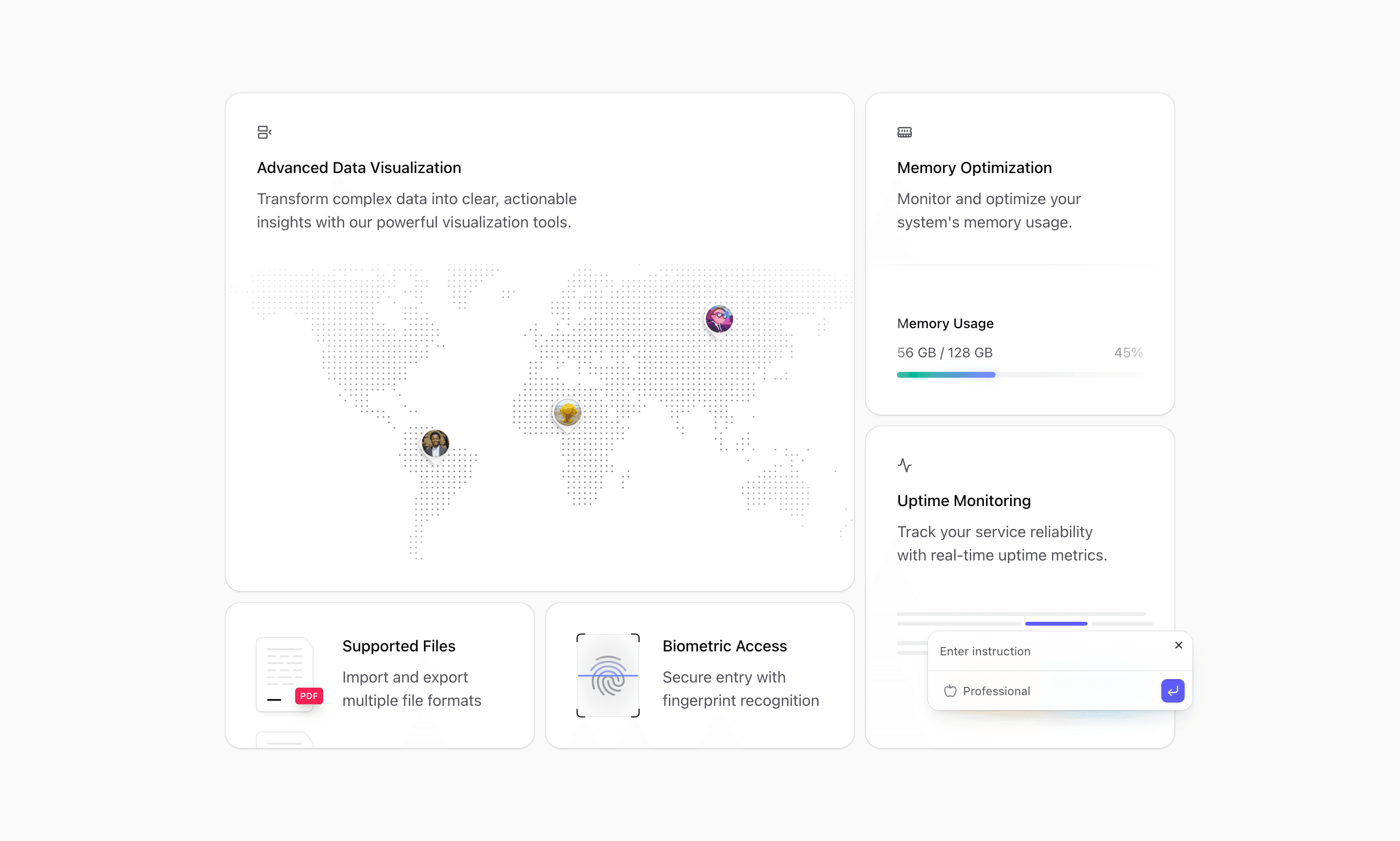
Bento block seven is built like an operations dashboard. It opens with a large map-based feature card, then surrounds it with smaller cards for supported files, biometric access, memory optimization, and uptime monitoring.
The code imports MapIllustration, DocumentsIllustration, FingerprintIllustration, MemoryUsageIllustration, and AIIllustration1, with Lucide icons for activity, memory, and layout. The result is a block that feels technical without becoming a table.
What makes this variant useful
The main card spans two columns and two rows on larger containers. That gives the map enough space to feel like a real product surface. Under it, two horizontal cards show compact capabilities: supported files and biometric access.
The right side gives you two vertical feature cards for system health. This makes the section useful for reliability, monitoring, security, infrastructure, or AI operations pages.
Best fit
Use this variant for products that monitor systems, visualize regions, track uptime, process files, or manage secure access. It is also a good fit for products that need to show both product UI and technical reliability in one section.
Implementation details
The grid uses @2xl:grid-cols-2, @2xl:grid-rows-2, and @4xl:grid-cols-3. The large map column spans two rows. The document card includes a hover effect that moves the document illustration upward with group-hover:-translate-y-[225%].
What to customize first
- Replace the map with a real product surface if geography is not part of your story.
- Use the small horizontal cards for details that should be scanned quickly.
- Keep the memory and uptime cards for operational proof.
- Test hover behavior after changing the document illustration.
Frequently asked questions
Does Bento Block Seven support dark mode?
Yes. The block uses theme tokens for backgrounds, text, borders, and muted foreground styling.
Is Bento Block Seven responsive?
Yes. The large map card and smaller cards reflow through container query breakpoints.
Can I customize the hover animation?
Yes. The document movement is controlled with Tailwind group-hover classes, so you can adjust or remove it.
What products fit this variant best?
Monitoring tools, infrastructure products, security dashboards, file platforms, and operations products.
Start from Tailark
Build with Tailark
Production-ready marketing blocks, pages, and illustrations for Shadcn UI.